
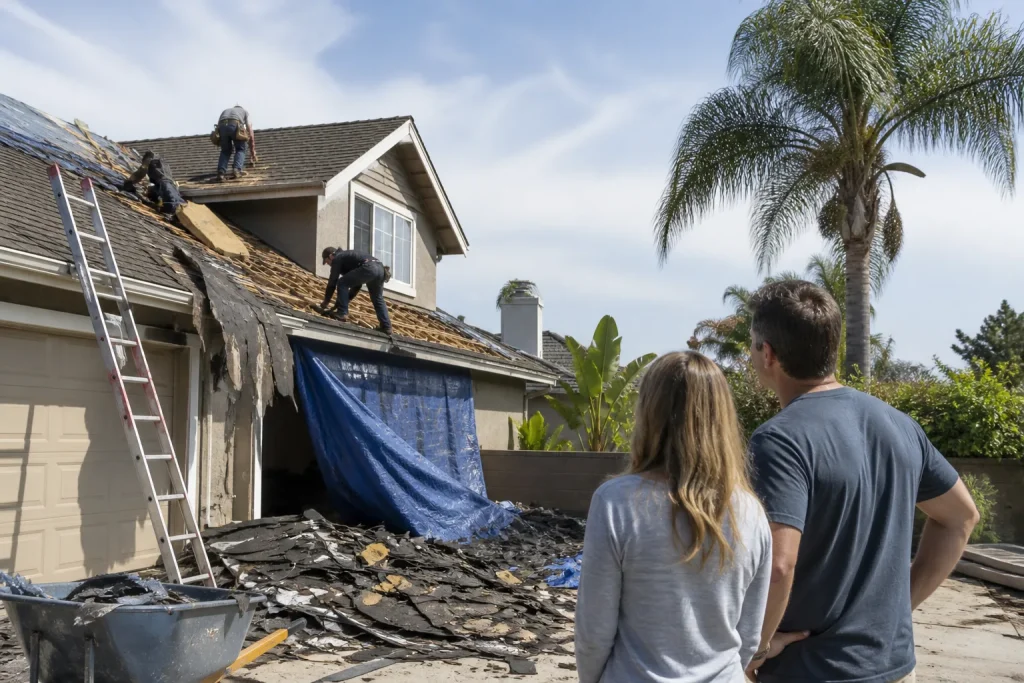
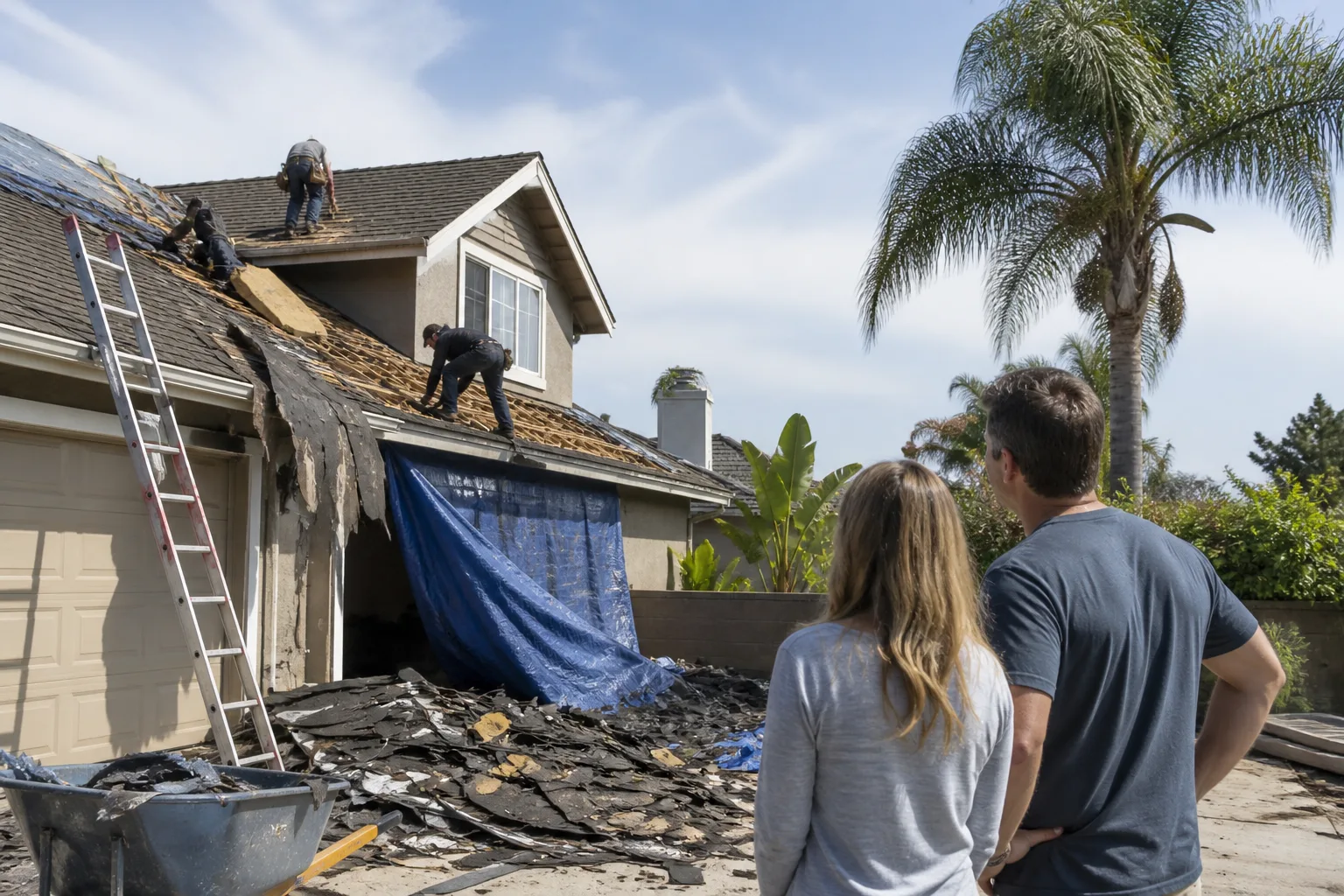
Emergency General Contractor Near Me: What Costa Mesa Homeowners Should Do First
Do not call a general contractor first after a pipe bursts, a fire chars a wall, or a tree comes through a window. Call your insurance company first, get the damage documented, then bring in a mitigation crew, and only then bring in a general contractor for the rebuild. If a contractor starts tearing out drywall or hauling away debris before an adjuster has seen the scene, your insurer can deny the claim because the extent of the damage can no longer be verified. That single mistake has cost Costa Mesa homeowners five-figure payouts.
If you’d rather not sort through this on your own at 2 a.m., you can call a live person at (855) 659-2556 and we’ll walk you through the sequence.
What’s the correct order of calls in a Costa Mesa home emergency?
The order is insurer, then mitigation, then general contractor. Each call has a legal job that the next one can’t do for you.
- Your insurance company. Open the claim and get a claim number before anyone touches anything. Ask them to send an adjuster, and ask whether you’re allowed to do emergency mitigation (shutting off water, tarping a roof, boarding a window) before the adjuster arrives. Most policies allow “reasonable steps to prevent further damage” and require you to take them, but the phone call is what documents that you did it by the book.
- A mitigation company. This is the crew that does water extraction, drying, mold prevention, board-up or smoke remediation. Their job is to stop the damage from spreading. Mitigation is usually billed separately from the rebuild, and most carriers treat it as a covered emergency expense.
- A general contractor. Once the scene is documented and the mitigation is underway or finished, a GC steps in to plan and price the actual rebuild: framing, drywall, cabinets, flooring, paint, permits.
Here in Costa Mesa, this sequence matters more than most homeowners realize. The city sits on a mix of older housing stock (lots of 1950s and 1960s single-story homes with cast-iron and galvanized plumbing) and newer construction near South Coast Metro. We’ve walked into slab leaks on the Eastside where the water had been quietly soaking the subfloor for weeks before the homeowner noticed. By then the damage crosses multiple trades, and the adjuster wants a documented sequence before a single cabinet comes out.
What’s the difference between an emergency mitigation contractor and a general contractor?
They’re not the same license, and they’re not the same job. A mitigation contractor handles drying, extraction, board-up and cleanup. A general contractor handles the reconstruction. Licensing is not interchangeable, and hiring one for the other’s work is where claims and code problems start.
In California, contractors are licensed through the Contractors State License Board (CSLB). A GC holds a Class B license and can take a project through permits, framing, finish and inspection. Water mitigation and restoration companies often hold a different classification, and mold remediation sits under its own set of rules. If a “restoration” van shows up and offers to handle the entire rebuild, ask to see both the license classification and the scope of work in writing. If the rebuild isn’t in their licensed scope, they’re subcontracting it out, and you’re signing the contract, not them.
Homeowners in Mesa del Mar and the Westside regularly get approached by restoration crews who show up within an hour of a big storm, sometimes before the fire department has cleared the scene. Ask for the license number before anyone opens a door. Then verify it. The CSLB lookup takes about two minutes and tells you whether the contractor is licensed, bonded, and what classifications they’re legally allowed to work under.
What should you document before anyone touches the damage?

Photos, timestamps, and a written description, in that order, from every angle, before a single board is pulled. This is the difference between a claim that gets paid and one that gets denied six weeks later.
- Wide shots of every affected room, including the doorway threshold so the adjuster can see how the damage spreads across the home.
- Close-ups of the source – the burst pipe joint, the scorched stud, the cracked window frame, the water line on the drywall.
- A photo of a clock or phone lock screen with the date and time, taken in the same frame as the damage. Audio timestamps vanish; visible timestamps don’t.
- Video walkthrough with narration. “This is the hallway by the second bedroom, water came through here at about 3:15.” Insurance adjusters love narrated video because it survives better than either photos or notes.
- A short written list of everything damaged that you can name: furniture, flooring, appliances, personal items. Include brand names and approximate purchase dates where you remember them.
- Your mitigation contractor’s moisture readings (if you’ve already called one) photographed on the meter, not just written on a report.
One local detail that comes up repeatedly in Costa Mesa: many homes near the Upper Newport Bay side sit on slab foundations with very little crawl space, so water damage shows up at the baseboards and cabinet kickboards before it shows up anywhere else. Photograph those areas even if they look fine. The evidence often looks worse under a moisture meter than it does to the eye, and you want that reading on record in the first 24 hours.
How do you spot a predatory “emergency services” contract?
A predatory emergency contract makes you sign for the entire reconstruction scope at 2 a.m. while the crisis is at its worst. The signature binds you to a price you haven’t seen, for work you haven’t scoped, from a crew you haven’t vetted. Read every line, and never sign an authorization that goes beyond mitigation without a written, line-item price.
Watch for these in the paperwork:
- An “authorization to proceed” that quietly includes reconstruction, not just emergency mitigation. That’s the tell. The contractor walks in with the name of the mitigation service and the signature line actually covers the full rebuild.
- A percentage deposit for damage that hasn’t been scoped. A number like “30% of total insurance proceeds” is not a line-item price. It’s a handshake that binds you to whatever they decide the total is.
- An assignment of benefits (AOB) clause that lets the contractor negotiate directly with your insurer and receive the payout. In California, AOBs are restricted, but they still show up in vehicle and property paperwork. If you see one in a home repair contract, ask why.
- Pressure to sign on site, before you’ve called your insurer or read the fine print. A legitimate crew will hand you a scope of work and tell you to sleep on it. No written price, no signature.
We’ve seen the flip side of this too. A homeowner in Halecrest signed an authorization for what she thought was water extraction, and the clause also covered a full kitchen rebuild at a price she could have negotiated down by more than half. By the time she called us, she was tied to the contract. The rebuild eventually happened through her insurer, but it was a painful detour that a written line-item price upfront would have prevented.
What happens when you call
- 1
A real person answersNo phone trees – you reach a local pro.
- 2
You get an upfront price rangeHonest numbers before anyone is dispatched.
- 3
A background-checked tech heads outLicensed & insured, dispatched right away.
- 4
You approve before work beginsNothing starts until you say go.
How do you vet a general contractor under time pressure?
There are two checks you can run in under five minutes that eliminate most of the risk: the CSLB license lookup and a certificate of insurance. Do both before you sign anything.
- CSLB license lookup. Go to the Contractors State License Board website (cslb.ca.gov), enter the license number on the contractor’s card, and confirm the status is active, the classification is Class B (or the appropriate specialty), and the business name matches. If a contractor can’t hand you a license number on the spot, that’s your answer.
- Certificate of insurance. Ask for a current certificate showing both general liability and workers’ compensation. Call the insurance agent listed on the certificate and confirm the policy is active, not lapsed. If a crew member gets hurt on your property and the contractor doesn’t carry workers’ comp, that injury can land on your homeowner’s policy.
Two more checks worth the ten extra minutes: a written line-item scope of work (every material, every labor line, priced), and a written guarantee term. Our 365-Day Done Right Promise is our way of putting that guarantee in writing and standing behind it for a full year after the project closes. If a contractor won’t put their guarantee on paper before work starts, keep looking.
For the rebuild side of an emergency, homeowners in Costa Mesa end up talking about kitchens and bathrooms a lot, because water damage so often lands in both. If your mitigation is winding down and you’re ready to scope the rebuild, our teams handle kitchen remodeling in Costa Mesa and bathroom remodeling in Costa Mesa with a written price before a single tool comes out. And if you’re still not sure who to call first, our general contractor in Costa Mesa page walks through how we approach projects from insurance scope to final walkthrough.
When should you call a pro instead of handling it yourself?
Call a pro when water is still moving, when the damage touches electrical or gas systems, or when it’s above your ceiling. A homeowner can shut off the main water valve, move furniture, and take photos. Anything past that, you want a licensed crew on the phone.
Anything involving a gas line, a flooded electrical panel, or a structural wall that’s been soaked through is a stop-and-call situation. Carbon monoxide and electrical shock are real hazards after a fire or a flood, and no amount of documentation is worth a hospital visit. Twice this year we’ve walked into situations where a homeowner had pulled a wet panel cover off “just to look.” Both times the panel was live. Shut the main breaker down from a dry spot, call the utility, and call a pro.
If the damage is contained (a small ceiling stain, an appliance leak you caught within the hour), you can usually document it, call the insurer, and handle the mitigation with fans and dehumidifiers. If the damage crosses a room, a wall cavity, or a floor, call a mitigation company first and keep your GC on standby. Our technicians have up to 22 years of experience across the rebuild side, and we work with 24/7 live-person phone coverage because emergencies in Costa Mesa don’t always happen during business hours.
Related services in Costa Mesa: our whole-home remodeling team handles the rebuild when the scope goes beyond one room. You can see the full picture on our Bradford Remodeling Co Costa Mesa home page.
The Bottom Line
The order of calls is the whole game: insurer, mitigation, general contractor. Document before anyone touches anything, verify licenses in minutes, and never sign a 2 a.m. authorization that binds you to reconstruction scope you haven’t priced. A general contractor’s job is the rebuild, not the emergency response, and mixing the two up is how claims get denied.
Every price we give is a written price before work starts, every completed project carries our 365-Day Done Right Promise in writing, and every crew member is background-checked and uniformed so you know who’s coming through the door. If you’re in Costa Mesa and need help sorting through a rebuild after a home emergency, Bradford Remodeling Co Costa Mesa offers free estimates – call (855) 659-2556. A live person answers, day or night.
Frequently Asked Questions
Yes, in almost every case, and you should call them the same hour if you can. Your policy requires you to report damage promptly and gives the insurer a right to inspect the scene before repairs begin. If remediation starts first and destroys the evidence, the insurer can deny the claim because the damage extent can’t be verified. Call the insurer, get the claim number, then move on mitigation. Call (855) 659-2556 if you want to talk through your situation – estimates are free.
Typical emergency water extraction and drying in Costa Mesa runs $1,800 to $4,500 for a small room, and $5,000 to $12,000 or more for whole-floor or whole-home mitigation with mold prevention. Board-up for a single window or door runs roughly $250 to $600. These are usually covered under the emergency mitigation portion of a homeowner’s policy, and most carriers expect a line-item invoice. Watch for “authorization to proceed” contracts that bundle reconstruction in with mitigation at a percentage-based fee rather than a line-item price.
Use the Contractors State License Board website at cslb.ca.gov, and enter the license number printed on the contractor’s card. You’ll see the license status, classification, and business name within two minutes. Pair that with a call to the insurance agent on the contractor’s certificate of insurance to confirm the general liability and workers’ comp policies are active. Both checks together take under five minutes and eliminate most of the risk. If you’re ready for a written estimate, call (855) 659-2556 – estimates are free.
It shouldn’t, and with us it doesn’t. We put a written price in your hand before any work begins, and the number doesn’t move at the door or mid-project. If your insurer later adjusts the scope of covered work, we price the change in writing separately so you can approve or decline it before any work starts. That’s the standard we hold every project to. For the rebuild side, call (855) 659-2556 to schedule a free estimate.
Written by the team at Bradford Remodeling Co Costa Mesa.
Need Construction Help?
Call Bradford Remodeling Co Costa Mesa - licensed & insured, here with fast after-hours help in Costa Mesa.
(855) 659-2556